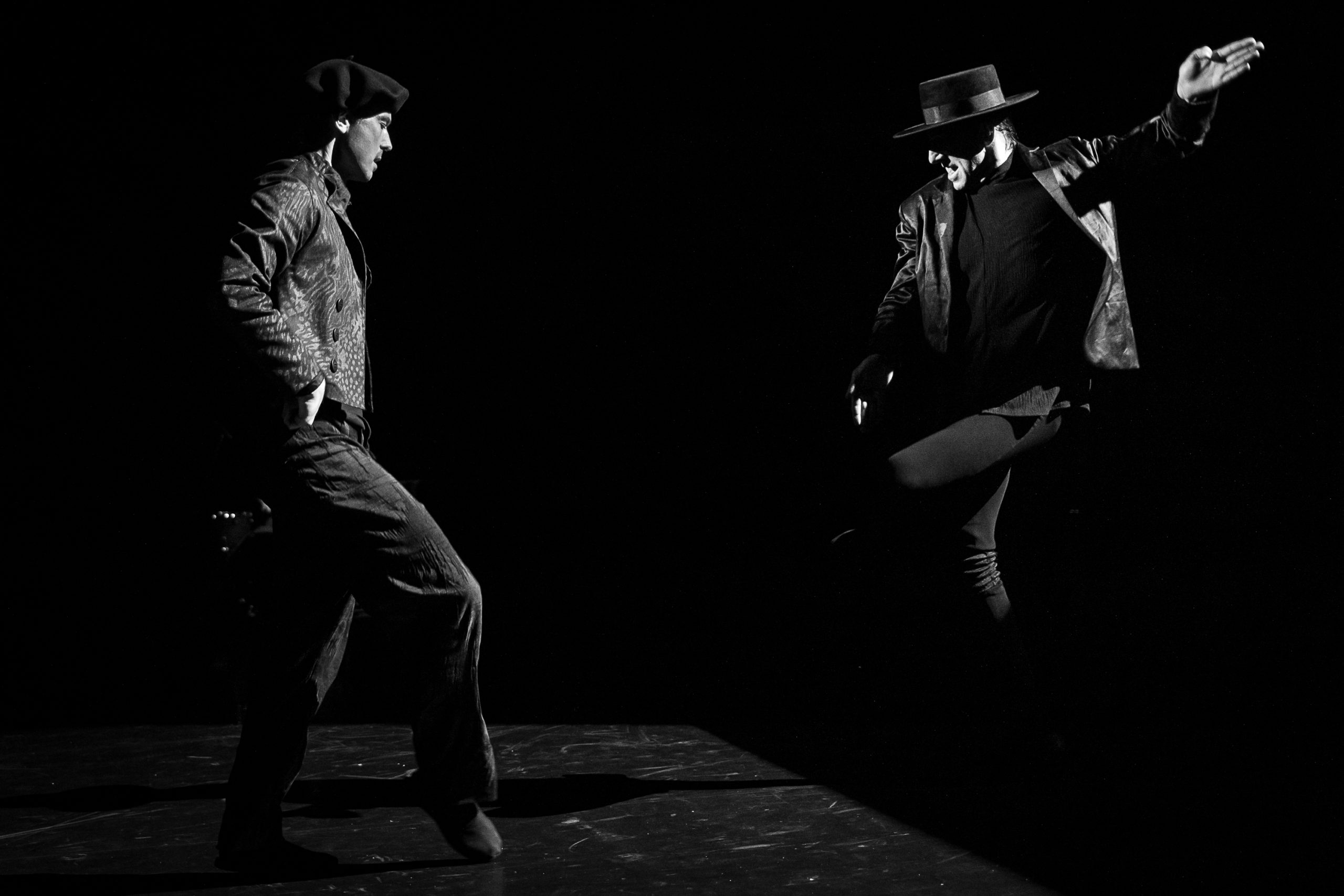
Kukai Dantza YARIN. Where Flamenco Meets Basque Dance
Kukai Dantza YARIN. Where Flamenco Meets Basque Dance: A Conversation in Motion
Kukai Dantza will perform Yarin by Jon Maya and Andrés Marin. Meaning root, encounter, and dialogue, in Yarin we find two men who look from their roots, who explore them as a way to relate to their surroundings. They arrive with their own origin and essence, they present an encounter to us; they dialogue… The dialogue is not always easy, it’s built by listening, respect… Sometimes it brings us together, sometimes it distances us, sometimes it makes us tense… and also embraces us. Yarin presents us with an intercultural encounter, where the dantzari (traditional Basque dancer) Jon Maya and flamenco dancer Andrés Marín, accompanied with live music by Julen Achiary, meet each other on the basis of an honest dialogue, showing their differences and their desire to share through them a common path towards tomorrow.
Recognized as one of Dance Magazine’s “25 to Watch” in 2024 and 2025 Jadin Wong Fellow, see a moderated discussion and in-process showing of Ikigai, an evening-length work exploring the 2011 Tohoku earthquake, tsunami, and Fukushima nuclear disaster through tap dance, live music, and storytelling. Drawing inspiration from her personal experience and that of her family and friends, Funaki reflects on themes of resilience, loss, and connection. The performance is a rhythm-driven exploration of the emotional and cultural impact of one of Japan’s most devastating tragedies. This presentation brings together a diverse cast of tap dancers, movement artists, and vocalists, underscoring tap’s power as a medium for storytelling and cross-cultural dialogue around cultural resilience in the face of catastrophic events.
Founded in 2001 in Errenteria in the Basque country, by dancer and choreographer Jon Maya, Kukai Dantza has developed a distinctive form of contemporary dance rooted in Basque culture.
Recognized as one of Dance Magazine’s “25 to Watch” in 2024 and 2025 Jadin Wong Fellow, see a moderated discussion and in-process showing of Ikigai, an evening-length work exploring the 2011 Tohoku earthquake, tsunami, and Fukushima nuclear disaster through tap dance, live music, and storytelling. Drawing inspiration from her personal experience and that of her family and friends, Funaki reflects on themes of resilience, loss, and connection. The performance is a rhythm-driven exploration of the emotional and cultural impact of one of Japan’s most devastating tragedies. This presentation brings together a diverse cast of tap dancers, movement artists, and vocalists, underscoring tap’s power as a medium for storytelling and cross-cultural dialogue around cultural resilience in the face of catastrophic events.
Founded in 2001 in Errenteria in the Basque Country by dancer and choreographer Jon Maya, Kukai Dantza has developed a distinctive form of contemporary dance rooted in Basque culture.
Kukai Dantza will perform Yarin by Jon Maya and Andrés Marin. Meaning root, encounter, and dialogue, in Yarin, we find two men who look from their roots, who explore them as a way to relate to their surroundings. They arrive with their own origin and essence, they present an encounter to us; they dialogue… The dialogue is not always easy, it’s built by listening, respect… Sometimes it brings us together, sometimes it distances us, sometimes it makes us tense… and also embraces us. Yarin presents us with an intercultural encounter, where the dantzari (traditional Basque dancer) Jon Maya and flamenco dancer Andrés Marín, accompanied by live music by Julen Achiary, meet each other on the basis of an honest dialogue, showing their differences and their desire to share through them a common path towards tomorrow.
JON MAYA SEIN (Errenteria, 1977)
Director, dancer and choreographer with Kukai Dantza. Maya took his first steps in the world of dance, specifically traditional Basque dance, at age six with the Ereintza dance group in Errenteria (Gipuzkoa, Basque Country). He participated with this group in international folklore festivals in several countries, and was seven-time Basque Champion of Aurreskularis (Basque ceremonial dancing) between 1997 and 2005. After taking part in the Laxok project in 1999 and 2001, he decided in 2002 to create Kukai Dantza. He wanted to “create contemporary performances based on traditional Basque dance”. He has developed and consolidated this idea with Kukai Dantza and in recent years has devoted his professional career to this concept and to firmly establishing the company, in his capacity as a dancer, choreographer and director.
The meeting of artistic languages and a capacity for collaboration are the principal hallmarks of his work. He regularly collaborates with several artists such as the choreographers Marcos Morau, Sharon Fridman, Israel Galván and Cesc Gelabert and artists from other disciplines including Andoni Luis Aduriz in gastronomy, Tanttaka Teatroa, Arena Comunicación in film, Bilbao Fine Arts Museum and the Navarre University Museum. He has been artistic director for prestigious events, e.g. gala director of the San Sebastián International Film Festival in 2020 and co-director of the Max Awards gala in 2016. He is a movement coach for various theatre productions in Madrid (Spanish National Drama Centre, Spanish National Classical Theatre Company, etc.) and has taught in the municipal dance school in Errenteria and delivered various workshops and master classes for renowned companies and festivals.
To quote the specialist critics, he is “an indispensable and multifaceted director and choreographer”.
ANDRÉS MARÍN
Andrés Marín is one of the most singular dancers of the current flamenco scene. His productions have focused on the flamenco tradition and specifically on the classical songs, but not from a conventional perspective, but through a very personal style and an aesthetic of absolute contemporaneity. Choreographer, artistic and musical director of his own company, his creations reflect the expressive freedom of a deep artistic research. From there is born a poetics rich in suggestive images, at the service of his commitment to art and to himself. He is currently one of the great renovators of the genre.
Andrés Marín was born in Seville in 1969. The son of flamenco artists, he has lived the art since he was a child, both through dancing at his father’s school, as well as singing, of which he is a great fan and profound connoisseur. If there is a trait that defines his career, it would be that of independence and non-attachment to any company or school beyond his father’s teaching. Self-taught and unclassifiable, he began his professional career in 1992 as a soloist and choreographer for different shows and events until he founded his own company in 2002.
In all of Andrés Marín’s works, experimentation and risk reign, elements that the artist considers essential for flamenco art to stay alive:
JULEN ACHIARY
Julen Achiary is part of a generation of Basque musicians who have come of age in an already proven world of Basque music. He has been shaped by the enriching dialogue that he has consistently had with Basque culture, and which continues to flourish.
His path, built along reliable and tenacious tracks, takes root in his connection with Basque singers from the La Soule province who have passed on their love of singing and the Basa Ahaide. It is not a path of static, exclusive music but is, quite the contrary, a path that embraces openness, encounters and sharing, of music reborn in creation.
The Basque Country has given him his love for dance, music and singing, which flows in his veins. Festivities and encounters set the tempo for his life growing up and, over the years, have introduced him to the world, the “Tout-Monde” already discovered at festivals in Uzeste, Itxassou… and not long after, in Africa, the Congo; then in Turkey and Azerbaijan, where he forged links between the sounds of the Caucasus and the Arbailles mountains in the Basque province of La Soule.
Thanks to all these legacies, Julen has built a unique musical identity that he particularly expresses through a constant pursuit of sounds and rhythm. Seeing him perform alongside his friends in such a committed way, with such barely-contained passion yet calmness of mind, capable of singing so intensely the polyphony of human emotions, it is possible to feel a force at work that has been forged from listening to his forebears, and which has been reborn through him with patience and discipline.
He radiates the joy of sharing songs that pass through him and that he passes on.
Photo Copywrite: Yarin Aurrestreinua